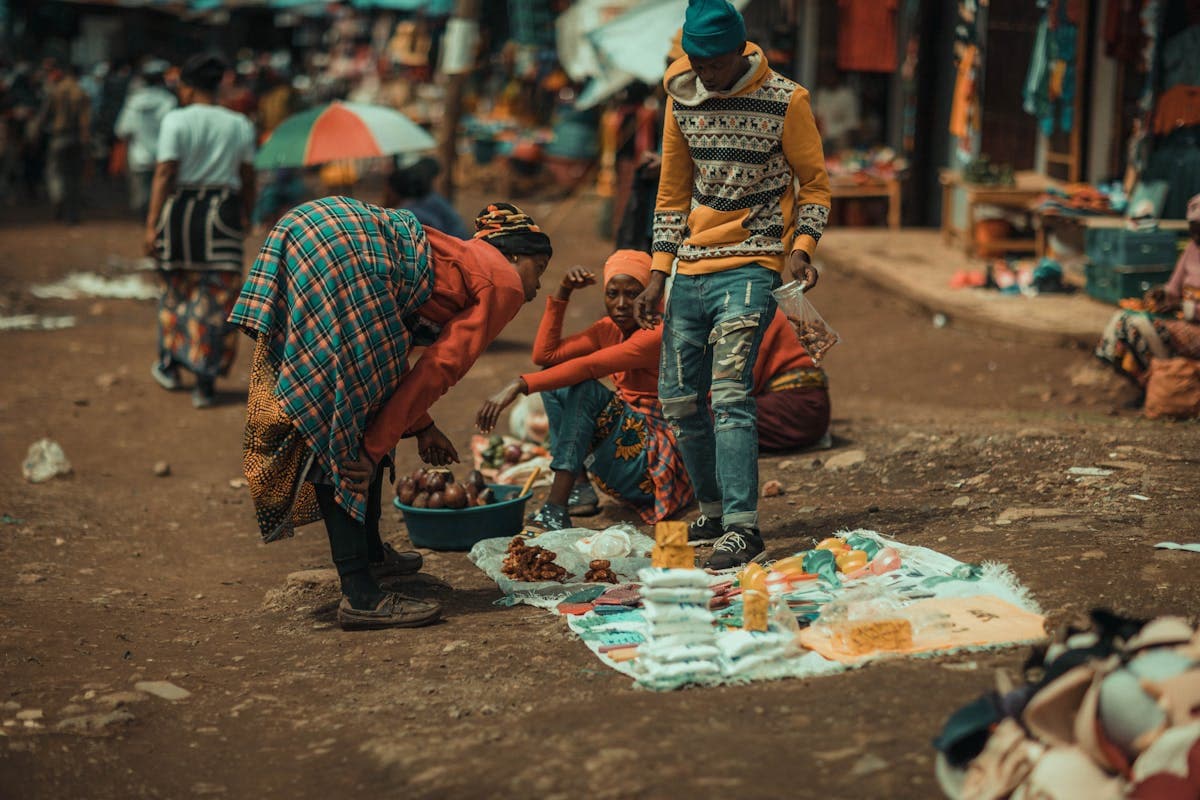
Cameroon's Informal Economy: An Opportunity for Millions of Workers
By the SangoServices team6 min read
In Cameroon, the informal economy isn't marginal — it IS the economy. 86.6% of employed people work in the informal sector (INS, EESI 3, 2021). In Douala, the country's economic capital, this translates to millions of people earning their living every day without an employment contract, without payslips, and often without protection.
SangoServices doesn't aim to forcibly "formalize" this economy. The goal is to provide the missing tools: connection, transparency and verifiable reputation.
Cameroon's informal economy in numbers
Cameroon's informal economy represents:
- 86.6% of employed people (informal sector, INS, EESI 3, 2021)
- An estimated contribution of 30-40% of GDP
- Diverse sectors: trade, manual labor, cooking, transportation, errands, domestic services
These workers aren't "informal" by choice. They are because the formal system doesn't offer them a place. No recognized degree, no professional address, no network — but real skills and a willingness to work.
Daily challenges for informal workers
An informal worker in Douala faces concrete challenges:
- Finding work — Word of mouth is limited and random
- Negotiating the price — Without standard rates, every task is a negotiation
- Getting paid — Cash creates disputes and delays
- Proving experience — Without a CV or formal references, hard to stand out
- Getting there — Transport is expensive and eats into earnings
How technology can transform the sector
The solution isn't asking informal workers to become formal. It's giving them the tools they don't have:
- A directory to be found in — SangoServices lets employers search for workers by trade, city and neighborhood, and contact them directly
- A visible rate — Every worker shows their minimum FCFA rate on their profile
- Direct payment — Cash or Mobile Money, no commission, no middleman
- A profile that builds trust — Phone is SMS-verified, identity can be checked by the team, and hires confirmed by employers are shown
- Barrier-free access — No CV required (and a free CV if needed), no app required, no bank account needed
17 service categories covering the real economy
SangoServices offers 17 categories that reflect the diversity of informal work in Douala:
Cleaning, driving, moving, repair, delivery, cooking, manual labor, helper, babysitting, elderly care, event staffing, gardening, laundry, security, teaching, errands and other services.
Each category is designed for the real needs of Douala residents.
The opportunity: structure without formalizing
Cameroon's informal economy doesn't need bureaucracy. It needs:
- Visibility — so workers can be found
- Trust — so employers can verify profiles
- Traceability — so every payment is proved
- Accessibility — so the tool works for everyone, even without the latest smartphone
That's what SangoServices is building, one profile at a time, in the neighborhoods of Douala and Yaoundé.
Join the movement. Create your free profile if you're looking for work, or find a worker if you're hiring.
SangoServices is a directory of workers in Cameroon, run by Sango Sarl in Douala. Our guides draw on our own data and on public sources, cited in the text. About us